
A Fine Dilemma: Small Items That Cause Big Problems for Recycling in The UK
One of the best parts of my job, and there are many best parts of my job, is travelling around the country visiting different material recovery facilities (MRF) or recyclers. It feels a little like the Forest Gump quote about a box of chocolate, every site is different and you never know what you are going to get. Completing real world sorting trials is one of the many recyclability services offered by RECOUP and it allows members and customers the chance to find out how their packaging is sorted ‘in the wild.’
Trials do often come with a lot of questions though:
“What sorting technology do they use and how is it calibrated?”
“What if I make the label 5mm smaller?”
“But it’s not carbon black, why did it fail?”
One of my favourite questions, however, comes when we have tested items that commonly fail at the size sort stage, and it is almost always the same question no matter who the test is for:
“What if we made it from another material?”
The same question has been asked by many packaging designers, and they always seem shocked by the answer they get:
“Fines. It will end up in fines.”
The questions are one of the main reasons we encourage attendance at trials. Many of the questions that are asked can be answered and a better understanding achieved when they have seen what happens for themselves.
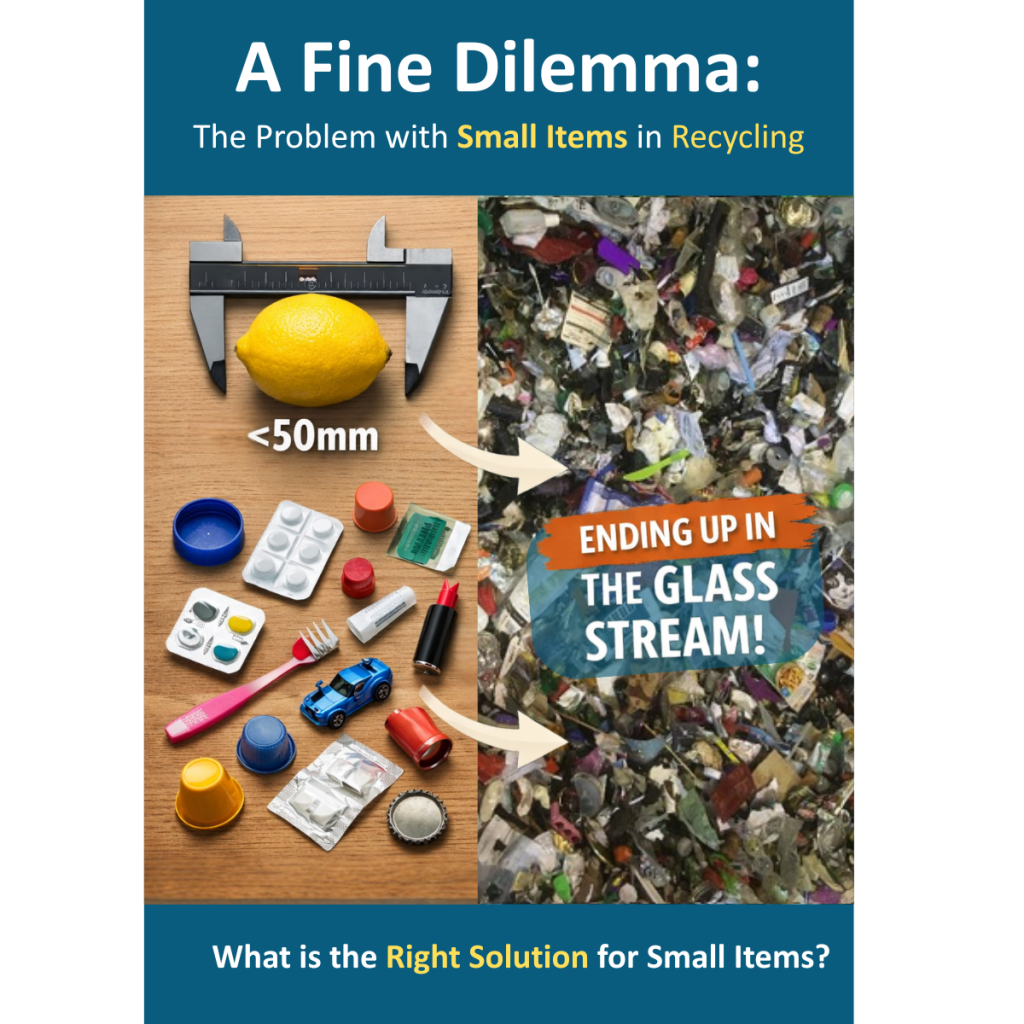
When we talk about fines, we are discussing the small items that are found in the glass fraction. Fines are one of those quietly critical issues that determine whether glass is genuinely recycled back into packaging or quietly downgraded to low-value aggregates or even waste.
Typically, in an MRF, dry mixed recyclables are sorted using a variety of screens, belts and optical sorters. The screens have openings of various sizes to separate materials by size. The initial sort has holes between 100mm to 400mm typically to remove larger items such as boxes with the packaging grades falling through. The next set of holes are between 40mm to 50mm, with 50mm being the most common. This phase is called the glass-breaker, as you can imagine, so named because it is where the glass breaks and falls through the 50mm holes.
Fines are the small items that fall with the glass. Some examples of items that fall through are toothbrushes, cosmetic and make-up packaging, blister packs, bottle tops and lids, small toys, coffee pods, lighters, small pieces of paper and foils, batteries and food residues. Glass reprocessors report taking in thousands of tonnes of fines within their glass each week. Estimates generally fall between 20%-30% by weight of non-glass items within the glass fraction, though this also includes ceramics and metals within the contaminants.
Most of the problematic items enter the glass fraction through a mixture of infrastructure, design and consumer behaviour. The fines problem is not a simple fix, there are multiple branches that combine to create a system-level problem in combination with collections, mechanical sorting and consumer behaviour. With convenience also now being a key consideration for many companies, size has become an issue that many did not even consider during design for recycling.
When it comes to any material being recycled, quality is value. Sites like Sherbourne Recycling invested millions of pounds into achieving the best possible purity for their PET bottle recycling. Recyclers pay for bales by weight, so for every kilo of non-target material, that is a kilo of lost value. The same applies for glass, each kilo of non-glass material needs to be removed, even small quantities of contamination can relegate glass from recyclable to aggregate, or out of the recycling market altogether. All of this conspires against the glass industry and MRF operators. Environment Agency guidance means that glass must contain minimal contamination to be considered as glass for recycling. With many MRF processes the contamination can exceed the tolerances, which in some cases can be anything greater than 10%-20% contamination being rejected as waste glass.
Some MRFs already have relatively efficient glass clean up systems, though many don’t. One site we visit has installed air filtration and trommels to remove light fractions such as paper and films and larger packaging with 20mm diameter holes in their trommel. This enables them to have three glass grades, with two qualifying as recyclable glass. Another site has installed magnets or eddy-currents as their only glass clean up, swapping costs for rebate on their reclaimed metals.
From a RECOUP perspective, naturally we have a lot of members with an interest in plastics recycling and cross-material contamination is a big issue. Many of the items contaminating the glass stream are plastics, though all materials have a part to play in the fines dilemma. We feel that this is a challenge that needs collaborative and evidence-based solutions rather than any finger pointing and shouting. In 2020 RECOUP produced a report looking at small items in the recycling stream and highlighted a series of possible solutions and workstreams. Despite this, nearly 10 years later we are still looking at the same problems.
Quality recycling is everyone’s business, everyone wants to recycle, but with the breadth and depth of the problems we face, it is going to take a collaborative effort from all parties to see real change.
RECOUP is keen to collaborate with key stakeholders to:
- Work with MRF operators and glass reprocessors to perform composition analysis on a range of glass sorting systems at MRFs to understand the operational impacts and to categorise which items and products are the most problematic.
- Support local authorities and waste operators in evaluating how effective collection and sorting infrastructure is and advise on infrastructure and service changes to reduce contamination.
- Explore practical routes with brands and retailers placing materials on the market to establish suitable recycling routes for their products, from kerbside recycling through to take-back schemes and alternative materials where it makes environmental and economic sense.
If you are asking the same questions as we are and looking for solutions, but don’t know where to turn, we would like to talk. By combining real-world data and our unique position within the waste management community and plastics value chain, we believe we are in prime position to deliver meaningful change to decrease contamination and improve the recycling rate of small items. If you feel the same way, we can’t wait to hear from you.